Sunlight
Chasing SunlightSunlight is the decisive reality around which Jonathan Heights’s expedition, identity, and final transformation are organized. In a world of lightless skies, it is first dismissed as a fairy tale; for Jonathan, however, it is a remembered experience of perfect clarity that gives his life direction. It is at once a physical illumination, an inward power rooted in the soul, and a revelatory condition in which the distinction between seeing and understanding collapses.
Myth, Memory, and the Expedition
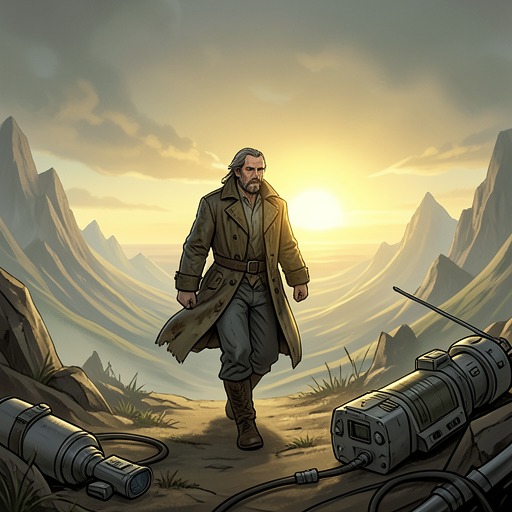
Sunlight enters the story as an object of disbelief. The dominant assumption is summarized by the repeated assertion, “Sunlight is a myth.” Jonathan Heights stands against that consensus because he claims to have witnessed it before. He describes the sight as the most beautiful thing he has ever seen: a single ray descending from the heavens with such clarity and purity that it burned itself permanently into his soul. The memory makes ordinary existence appear faded and dull by comparison, but it also supplies strength and purpose. His expedition to the far east is therefore not an abstract search for a legend; it is an attempt to recover an encounter that has already divided his life into a before and an after.
Jonathan treats the search as non-negotiable. When opponents or officials threaten to interfere, he states that nobody will stop him from finding sunlight. He warns that any further agent sent to accompany the expedition will be dead before the party leaves the city, making clear that he considers outside supervision not merely inconvenient but fatal to the mission. His insistence that he has seen sunlight also becomes a guarded secret. He tells André that he is following sunlight but refuses to disclose more, preserving the knowledge as both a strategic advantage and a private possession.
The Illuminated King takes an interest in the report that Jonathan has found sunlight, and Jonathan doubts the stated motive. The light he has encountered appears to possess a certain hollowness beside his memory of the sun’s radiance, leading him to suspect that the Illuminated King wants to harness it rather than understand it. This distinction establishes an important contrast: institutional power sees light as something that can be appropriated, while Jonathan’s commitment depends on its purity and on the transformation it produces in the person who confronts it.
The expedition of the Endeavor converts the private memory into a public and political undertaking. The ship leaves Beacon under the authority of the Illuminated King and with the nefarious endorsement of the Reflected Council, carrying Jonathan Heights eastward through a world where human civilization’s blue-white zint illumination meets territories and peoples it calls savage. At Danby’s Point, the human plateau ends at a great metal gate separating the human settlement from darker forces, while the Verdant Expanse beyond it shifts like a changing tide. Jonathan’s maps are essential because the eastern lands offer few safe places to anchor or resupply. His pursuit of sunlight thus travels through the practical machinery of exploration, mapping, trade, border control, and coercive civilization.
Sunlight as an Inner Force
Before the final revelation, sunlight is already active within Jonathan Heights. While assembling the Triskolabe from copied designs, he struggles to reproduce the required angles and distances, each completed ring fitting into a sliding armature through arrangements that defy human comprehension. Earlier, the work demanded long rests and brute effort; now, the sunlight burning inside him drives both his fingers and his mind. The remembered radiance has become an operative force, allowing him to perform labor that previously exceeded his endurance.
The same inward presence sustains him during danger. As an apocalyptic glow pursues the expedition, Jonathan remains capable of moving forward because the sanctity of sunlight is rooted deeply within him. Later, when a hungry silence threatens to pull the travelers backward, his will remains steel and his soul is described as sunlight; no malicious spirit can entrap him. These moments make the state more than a metaphor for optimism. Within the narrative, sunlight actively contests hostile environments and supernatural pressures, giving Jonathan a resistance that ordinary courage alone cannot explain.
Its power is also dangerous because it can become an absolute. In a city whose whispers attempt to influence him, Jonathan releases some of his control and feels sunlight rise from his soul to drive those suggestions away. Under its dominion, nothing else seems to matter and no other influence can take hold. Yet he recognizes the risk of losing sight of the steps between himself and the goal. Sunlight grants immunity to distraction while threatening to erase proportion, patience, and the intermediate obligations by which a human being reaches any destination.
This narrowing of value governs his choices throughout the expedition. Jonathan refuses to divert the Endeavor into surveying and cleansing Angkor Leng for the Inquisition, arguing that the party is not a navy and lacks the time and resources to undertake such a campaign. Whether the Umbraught are truly a threat is less important to him than the fact that the operation would delay the journey. His entire ethical and practical scale has been reordered around sunlight: danger, duty, scholarship, and political service are judged according to whether they advance or obstruct the search.
Revelation and Contagious Transformation
Sunlight changes the meaning of knowledge. Jonathan once pursued secrets and histories through forgotten stacks, and even a later visit to a bookstore evokes the intellectual life of his youth. The familiarity of handling books briefly recalls that earlier vocation, but the sunlight within his soul immediately makes those pursuits feel hollow by comparison. He has not ceased to value understanding; instead, ordinary forms of inquiry now appear partial beside the direct revelation promised by sunlight.
This contrast becomes explicit in Jonathan’s judgment of the power beneath Angkor Leng. The fevered god-dream and its vast imaginings are not denied as real, but compared with sunlight they become tales spun by firelight, passing fancies given form by the closeness of shadow. The distinction is not between reality and illusion in a simple sense. Other wonders may be genuine, powerful, and dangerous, yet sunlight occupies a higher order because it reveals rather than merely produces marvels.
Sunlight also alters what it touches. When Jonathan releases its presence against the Black Garden’s dark vines and crimson appetite, the light denies the primacy of the garden’s darkness. The Black Garden responds through Eleanor McAvey, perceiving the light and joining its knowledge to Jonathan’s without either side fully understanding the other’s secrets. The result is a palpable change in the garden’s nature: darkness shifts toward something greener and greater, flourishing in the one true light. The transformation shocks through Eleanor and echoes back to the source of the secret. Jonathan later reports that mere exposure to sunlight changed the Black Garden and that it had learned something.
The episode complicates any simple opposition between light and darkness. Sunlight does not merely annihilate the Black Garden; its contact produces mutation, growth, and knowledge. The light is purifying from Jonathan’s perspective, but it is also invasive and generative, entering a system whose own nature reacts and develops. Its effects therefore extend beyond Jonathan’s private enlightenment into the biological, supernatural, and political structures surrounding the expedition.
The Light of Truth in Bright Defile
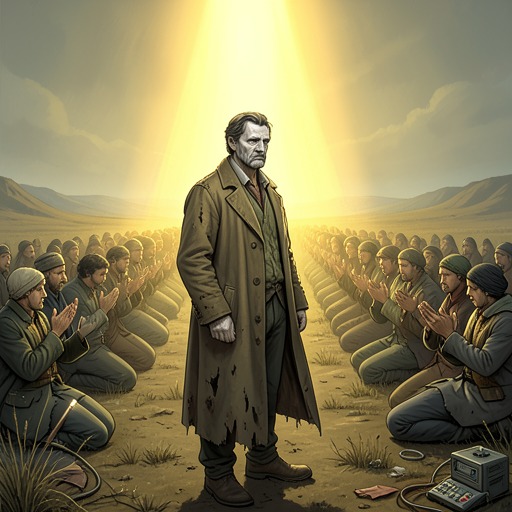
At the end of the journey, sunlight ceases to be only memory or inward force and becomes directly visible. It breaks from a narrow valley between two looming mountains, filling Bright Defile with a single ray that is bright, pure, and perfect. The illumination casts no shadows, only more light. It intensifies color beyond what ordinary reality can sustain, rendering trees, flowers, and the landscape with extraordinary vibrancy while sending warmth through body and soul. Its beauty confirms Jonathan’s earlier testimony, but the scene also insists that sunlight carries perils alongside its generosity.
To gaze upon sunlight is to understand immediately and intimately what is seen. The light contains an irrefutable revelation of its own nature, so that naming and knowing arrive in the same instant. This is not knowledge acquired through instruments, maps, books, or argument. It is an encounter in which the world becomes truly visible, and the observer cannot preserve the usual distance between perception and interpretation.
The effect is coercive as well as benevolent. One crew member moves toward the light as if pulled by an invisible hand, and Jonathan stops him. He warns the company that each step forward will allow them to see more, understand more, and become more, but also reminds them that they remain flesh and blood, shaped by a long history of mistakes and compromises. Sunlight forces self-confrontation, and the amount a person can endure becomes a personal limit rather than a general rule. Jonathan therefore presents the revelation as an invitation that must be approached with restraint.
When Jonathan steps onto the narrow path, the light thickens around him. Its pressure is not physical but spiritual, bearing on the self, on history, and on deeds. He welcomes the sensation because it resembles the relief of returning to solid ground after too long in rarefied altitudes. The demands of sunlight then expose lies, deceptions, uncertainties, secrets, and mysteries, rendering them plain or moot. The light’s truth is not comforting merely because it is truthful; it strips away the protections by which people maintain an incomplete but livable understanding of themselves.
The Final Barrier and Jonathan’s Departure
Jonathan’s approach culminates at a threshold beyond which no statues stand. A deep gulf separates him from the next stage, and the barrier of understanding becomes indistinguishable from the physical barrier in the land. Even the darkness in this realm defined by sunlight is completely legible, because Bright Defile permits no hidden nature and no secret remainder. The final obstacle can be crossed only if everything else is shed. To live in sunlight is to have no shadow left.
Beyond the valley lies a vast green country with mountains, white clouds, rivers, and a blue sky. Every leaf, blade of grass, stone, and drop of water bears the secrets of time and space, while the sun itself is older than worlds and older than time, greater than anything imagination could contain. The shrouded lands Jonathan has crossed shrink behind him into a dim mote suspended between sunbeams, an overlooked corner of creation. The image reverses the expedition’s original geography: the darkness that once seemed like the whole world becomes peripheral once sunlight has disclosed the larger reality.
Jonathan feels the sun’s warmth on his face, a wild wind at his back, and the freedom of truth before him. He smiles. The ending confirms sunlight as a supernatural reality rather than leaving the story in the uncertainty of a traveler’s testimony, while preserving its power as an inward discipline: Jonathan reaches the light because the journey has forged him into someone who will not compromise when it matters. Sunlight is therefore not simply a destination. It is the standard by which he has remade himself, the force that has sustained and narrowed him, and the revelation that finally carries him beyond the world of shadows.